Sunday, April 11, 2010

Capitalism vs. The Muslim Right to Look Like a Terrorist

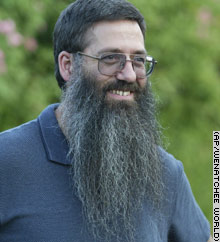
We all know nothing should make you feel secure like the sight of a righteous Muslim beard right across town from Ground Zero

Muslim Sues NY Hotel For Clean Shaven Rule

Updated: Sunday, 11 Apr 2010, 11:00 AM EDT Published : Sunday, 11 Apr 2010, 11:00 AM EDT

(NewsCore) - A devout Muslim is suing New York City's Gramercy Park Hotel because it would not hire him as a security guard unless he shaved his beard, according to a lawsuit reported in Sunday's New York Post.

Samir Suljovic, 24, claims he was the subject of religious discrimination when a hotel manager told him company policy required all employees to be clean shaven.

The luxury hotel did not respond to requests for comment.


Follow ECR on Facebook

Wednesday, April 7, 2010

New, "Even More Confusing" ObamaCare Surprising to Some


Believe it or not, some people are actually surprised to find that the federal government is already making healthcare more inefficient and confusing. Insurance brokers are being bombarded with calls with people wanting to know where they can get their "Obamacare" and "free healthcare." I despise socialism as much as the next rational person, but I wonder how the hell we'll ever beat it back when we have so many government-educated nitwits who just want to vote themselves free stuff.


WASHINGTON — Two weeks after President Barack Obama signed the big health care overhaul into law, Americans are struggling to understand how — and when — the sweeping measure will affect them.

Questions reflecting confusion have flooded insurance companies, doctors' offices, human resources departments and business groups.

"They're saying, 'Where do we get the free Obama care, and how do I sign up for that?' " said Carrie McLean, a licensed agent for eHealthInsurance.com. The California-based company sells coverage from 185 health insurance carriers in 50 states.

McLean said the call center had been inundated by uninsured consumers who were hoping that the overhaul would translate into instant, affordable coverage. That widespread misconception may have originated in part from distorted rhetoric about the legislation bubbling up from the hyper-partisan debate about it in Washington and some media outlets, such as when opponents denounced it as socialism.

"We tell them it's not free, that there are going to be things in place that help people who are low-income, but that ultimately most of that is not going to be taking place until 2014," McLean said.

Adults with pre-existing conditions are frustrated to learn that insurers won't have to cover them until 2014 (though those under 18 will be protected in late September); then they become both hopeful and confused upon learning that a federal high-risk pool for them will be established in the next few months. "Health insurance is so confusing. You add this on top of it and it makes it even more confusing," McLean said.

The Obama administration is embarking on a years-long public education campaign about the overhaul, including a Web component. However, much of the guidance will depend on Department of Health and Human Services regulations that are still being developed.

Parents of young adults, including those who are preparing to graduate from college this spring, have heard that the overhaul will let them keep their children on their insurance plans until they reach age 26. That starts in September, however; they have to determine how to cover them until then.

A new wave of inquiries could come next month as federal COBRA subsidies for laid-off workers dry up.

Ann Wooten of Austin, Texas, a breast cancer survivor, said she didn't understand whether the health insurance overhaul law meant that she should try to access private coverage again someday. She was diagnosed with breast cancer in 2008 after she lost her insurance in a divorce, and soon after she lost her job at a convenience store as a result of the economic crisis.

Medicaid has covered her treatments but she must apply regularly to renew the coverage. She went back to school to learn hotel management and is seeking a good-paying job with benefits. She doesn't know how the health overhaul will affect her options, and hasn't yet found the time or energy to investigate.

Americans who already have good coverage aren't so worried about the immediate implications, but some admit that they're plenty confused.

"Why does it take so long for certain health care things to take effect?" said Sandra Preston, a state employee in Paterson, N.J.

Ben Wiesen, a software engineer who works for a small company in Tarrytown, N.Y., said he'd read up on the overhaul but remained concerned about the unknowns.

"The timelines have been pretty clearly stated," he said. "It's the execution and the details: How are they really going to roll out the changes, and who ultimately will be the arbiter and decision-maker?"

Actor Sam Robards, the son of Lauren Bacall and the late Jason Robards, was visiting Washington last week with his children and Danish-born wife. Chatting in front of the White House gate, he said he tried to follow news coverage of the overhaul but conceded that "I'm not totally clear" on the details. He said he was glad that he got good coverage through the Screen Actors Guild so he didn't have to worry about it.

The couple previously lived in Denmark, which has universal health coverage. They applauded the overhaul's aim of extending coverage to nearly all Americans.

Many small business owners are nervous about requirements being phased in.

"Members are still trying to wrap their head around everything that's in this law," said Michelle Dimarob, the manager of legislative affairs for the National Federation of Independent Business, the small-business lobby.

Dimarob said the lobby's primary concern was that its costs would rise over the next four years as a result of fees, taxes and coverage mandates related to the overhaul.

"The next question that comes out of their mouths is: 'What do I have to do right now?' They need to start talking with their accountant, depending on how they're organized, what industry they're in and whether they're offering insurance now and what kind they're offering. We're suggesting they talk to their agent or broker."

Suntan businesses face a new excise tax starting in July as part of the overhaul. Other business owners are trying to understand new Internal Revenue Service reporting requirements related to business-to-business transactions that will kick in as a result of the new law. Others are looking ahead to coverage mandates for 2014 and calculating how many part-time versus full-time employees they should have to best contain costs.

While Obama has been touting a tax credit for small businesses that offer employees health coverage, Dimarob said many small businesses wouldn't be able to participate. First they must do research to see whether they qualify. "It requires them to understand the intricacies," she said.

The president has begun traveling the country to talk about the new law to ordinary Americans. In Maine last week, he explained many highlights of the four-year phase-in. However, Obama's remarks were laced with enough political rhetoric to dilute his policy message.

Many organizations have produced timelines explaining when provisions are to be phased in. Still, it's confusing for consumers, and until the administration issues more regulations, many details can't be pinned down.

"The first meeting the president held with the team post-passage was on implementation," White House Press Secretary Robert Gibbs said. "Obviously this is a big task, and a campaign to ensure that people understand what benefits are coming online when obviously will be tremendously important."


Read more: http://www.mcclatchydc.com/2010/04/06/91696/health-care-overhaul-spawns-mass.html#ixzz0kTrHriHl

Follow ECR on Facebook

Explosive Secret Diagram Shows Guam Tragedy Imminent!


When US Rep Hank Johnson voiced his concern about Guam tipping over from too many people, most of us just laughed. Now this explosive scientific diagram has surfaced, showing that engineers have long feared exactly this type of situation. If action is taken to save this pristine island from tragedy, we can all thank US Rep Hank Johnson and the Democrats, the party of science. Who looks stupid now, huh?

Follow ECR on Facebook

Jobless Recovery? The Peeps Ain't Buying It


Unlike in the book of Daniel, we do not require any special insight to read the writing on the wall. It seems pretty clear that people know all that BS about a jobless recovery was exactly that - BS. Consumers aren't borrowing money because they have no idea how to repay it. Repayment implies some form of income. The path ahead is clear- we must find a way to legislate optimism.

Consumer borrowing falls $11.5 billion in February

Consumer borrowing declines in February, reflecting weakness in credit cards and auto loans


WASHINGTON (AP) -- Consumer borrowing fell again in February, reflecting weakness in credit cards and auto loans. It marks a setback to hopes that consumers are beginning to feel more confident and will start spending more.

The Federal Reserve said Wednesday that borrowing declined by $11.5 billion in February, surprisingly weaker than the small $500 million gain that economists had expected. The February decline was the 12th decrease in the past 13 months as consumers slash borrowing in the face of a deep economic recession and high unemployment.

In January, borrowing rose by $10.6 billion, a gain that had broken a record 11 consecutive declines.

In percentage terms, the January increase represented a rise of 5.2 percent at an annual rate while the February decline marks a drop of 5.6 percent.

The February weakness reflected a sizable 13.6 percent drop in revolving loans, the category that includes credit card debt, and a smaller 1.6 percent decline in nonrevolving loans, the category that covers auto loans.

A revival in consumer borrowing and spending is seen as crucial to providing support for the overall economy, which is still struggling to emerge from the worst recession since the 1930s.

Federal Reserve Chairman Ben Bernanke said Wednesday that the economy seems to have stabilized and is growing again but threats remain.

"We are far from being out of the woods," Bernanke told a business audience in Dallas. "Many Americans are still grappling with unemployment or foreclosure or both."

Economists are hoping that consumer borrowing will stabilize in coming months and resume growing although they caution that the rebound will be restrained by tighter credit restrictions imposed by many banks in the wake of the financial crisis.

Consumers who would like to borrow are finding it hard to get credit at banks, who are being pushed by regulators to bolster their lending standards.

The $11.5 billion decline in consumer borrowing in February pushed total borrowing down to $2.45 trillion, 4 percent below where it was a year ago. The Fed's measure of consumer credit excludes home mortgages and other loans secured by real estate.

While economists have for years worried about the low rate of personal savings in the United States, analysts are now concerned that unless borrowing stabilizes it could derail the recovery because it will crimp consumer demand. Consumer spending accounts for 70 percent of total economic activity

.


Follow ECR on Facebook

Obama's New Tone of Submission to Islam


What does a college-campus Ivy League liberal do when confronted with a bloody, violent clash of culture and civilization that threatens to exterminate the freedom and liberty that is our heritage and birthright as Americans? Submit as quickly and as thoroughly as possible.


WASHINGTON — Less talk about "Islamic radicalism" and a lot more about doing business. In the year since President Barack Obama pledged a new beginning in the relationship with the Muslim world, the White House has begun to change the U.S. focus.

Terrorism still dominates U.S. security concerns, but the White House believes it doesn't have to dominate the conversation. Since Obama's speech in Cairo last year, the White House has tried to talk more about health care, science and education.

It's a strategy based on the belief that the prior administration viewed the world through the lens of terrorism. And when it talked to Muslim nations, it was all about winning the war of ideas.

"You take a country where the overwhelming majority are not going to become terrorists, and you go in and say, 'We're building you a hospital so you don't become terrorists.' That doesn't make much sense," says National Security Council staff member Pradeep Ramamurthy.

Ramamurthy runs the administration's Global Engagement Directorate, a four-person team that Obama launched last May with little fanfare and a vague mission to use diplomacy and outreach "in pursuit of a host of national security objectives." Since then, the division has not only helped change the vocabulary of fighting terrorism but has shaped the way the country invests in Muslim businesses, studies global warming, supports scientific research and combats polio.

Also, Obama advisers who are rewriting a document spelling out the country's national security strategy plan to leave out references to "Islamic radicalism," counterterrorism officials said. They spoke on condition of anonymity because the document is still being written and is weeks away from release. Currently, the document declares: "The struggle against militant Islamic radicalism is the great ideological conflict of the early years of the 21st century."

Ramamurthy's team is reaching out in a variety of ways. Before diplomats go abroad, they hear from him or his deputy, Jenny Urizar. When officials from the National Oceanic and Atmospheric Administration returned from Indonesia, the NSC got a rundown about research opportunities on global warming.

Ramamurthy maintains a database of interviews conducted by 50 U.S. embassies worldwide. And business leaders from more than 40 countries head to Washington this month for an "entrepreneurship summit" for Muslim businesses.

"Do you want to think about the U.S. as the nation that fights terrorism or the nation you want to do business with?" Ramamurthy said.

Many international Muslim leaders have cheered the new tone, not just for its symbolism but because it makes it politically easier for them to cooperate with the U.S.

"It's also a clear indication of President Obama's substantial understanding of the intricacies of Muslim politics," Jordanian lawmaker Hamada Faraaneh said.

On Wednesday, Iraqi government spokesman Ali al-Dabbagh applauded indications that the Obama administration would keep religious rhetoric out of the U.S. security strategy.

"It is a good message of assurance, and differs from the former American administration's position on this matter which showed no real understanding of Islamic countries," al-Dabbagh said. "This decision by Obama will help to reform the image Muslims have of America."

Public opinion polls have shown consistent improvement in sentiment toward the U.S. within the Muslim world, though the viewpoints are still overwhelmingly negative.

To deliver his message, Obama's speechwriters have at times taken inspiration from former President Ronald Reagan. In China in 1984, Reagan spoke about education, space exploration and scientific research. He discussed freedom and liberty. He never mentioned communism or democracy.

"They didn't look up to the U.S. because we hated communism," said Deputy National Security Adviser Ben Rhodes, Obama's foreign policy speechwriter.

Like Reagan in China, Obama in Cairo made only passing references to terrorism. Instead he focused on cooperation. He announced the U.S. would team up to fight polio with the Organisation of the Islamic Conference, a multinational body based in Saudi Arabia. The U.S. and OIC had worked together before, but never with that focus.

"President Obama saw it as an opportunity to say, 'We work on things far beyond the war on terrorism,'" World Health Organization spokeswoman Sona Bari said.

Polio is endemic in three Muslim countries — Nigeria, Pakistan and Afghanistan — but some Muslim leaders have been suspicious of vaccination efforts, which they suggested were part of a CIA sterilization campaign. Last year, the OIC and religious scholars at the International Islamic Fiqh Academy issued a fatwa, or religious decree, that parents should vaccinate their children.

The Centers for Disease Control and Prevention also began working more closely with local Islamic leaders in northern Nigeria, a network that had been overlooked for years, said John Fitzsimmons, the deputy director of the CDC's immunization division.

Though health officials are reluctant to assign credit to any one action, new polio cases in Nigeria fell from 83 during the first quarter of last year to just one so far this year, Fitzsimmons said.

Obama did not invent Muslim outreach. President George W. Bush gave the White House its first Quran, hosted its first Iftar dinner to celebrate Ramadan and loudly stated support for Muslim democracies like Turkey.

But the Bush administration struggled with its rhetoric. Muslims criticized Bush for describing the war on terrorism as a "crusade" and labeling the invasion of Afghanistan "Operation Infinite Justice" — words that were seen as religious. He regularly identified America's enemy as "Islamic extremists" and "radical jihadists."

Karen Hughes, a Bush confidante who served as his top diplomat to the Muslim world in his second term, urged the White House to stop.

"I did recommend that, in my judgment, it's unfortunate because of the way it's heard. We ought to avoid the language of religion," Hughes said. "Whenever they hear 'Islamic extremism, Islamic jihad, Islamic fundamentalism,' they perceive it as a sort of an attack on their faith. That's the world view Osama bin Laden wants them to have."

Hughes and Juan Zarate, Bush's former deputy national security adviser, said Obama's efforts build on groundwork from Bush's second term, when some of the rhetoric softened. But by then, Zarate said, it was overshadowed by the Guantanamo Bay detention center, the abuses at Abu Ghraib prison and a prolonged Iraq war.

"In some ways, it didn't matter what the president did or said. People weren't going to be listening to him in the way we wanted them to," Zarate said. "The difference is, President Obama had a fresh start."

Obama's foreign policy posture is not without risk. Even as he steps up airstrikes abroad, he has proven vulnerable to criticism at home, such as the failed Christmas Day airline bombing and the announced-then-withdrawn plan to prosecute self-described 9/11 mastermind Khalid Sheikh Mohammed in New York.

Peter Feaver, a Duke University political scientist and former Bush adviser, is skeptical of Obama's engagement effort. It "doesn't appear to have created much in the way of strategic benefit," he said. Obama risks seeming to adopt politically correct rhetoric abroad while appearing tone-deaf on security issues at home, Feaver said.

The White House dismisses such criticism. In June, Obama will travel to Indonesia, the world's most populous Muslim country, and is expected to revisit many of the themes of his Cairo speech.

"This is the long-range direction we need to go in," Ramamurthy said.

Follow ECR on Facebook

Obama: We Support Georgia, Really We Do


Based on how we've recently treated our "special" allies in Israel and the UK, I think this support is worth about as much as a wedding day promise from Tiger Woods. I would advise Mr. Saakashvili to be careful where he places his trust, or he could find himself wishing he'd been more circumspect about the people he relies upon.

Obama assures Georgia's Saakashvili of U.S. support

WASHINGTON (Reuters) - President Barack Obama, in a gesture of support before meeting his Russian counterpart later this week, assured Georgia on Tuesday the United States backed the pro-Western country's independence.

"The President relayed the strong support of the United States for Georgia's sovereignty and territorial integrity," the White House said, describing a telephone conversation Obama held earlier with Georgian President Mikheil Saakashvili.

Obama will meet with Russian President Dmitry Medvedev on Thursday in Prague, where the two leaders will sign a nuclear arms reduction treaty.

Russia invaded Georgia in August 2008 after an assault by U.S.-trained Georgian military on the breakaway pro-Russian territory of South Ossetia.

ad_icon

Obama and Saakashvili "discussed the importance of all sides avoiding provocative actions to build stability in the region," the White House said in a statement.

U.S. naval forces exercised with the Georgian coastguard in the Black Sea last month and the Pentagon said on Friday it would build the military capabilities of Georgia, and Baltics states bordering Russia, to ready them for operations in Afghanistan. Georgia deploys troops to fight alongside U.S. Marines this month in Afghanistan's Helmand province.


Follow ECR on Facebook

Obama's Secret Plan to Make College Unaffordable


I know, I know. Liberals want EVERYONE to have a FREE education. That's what they say, at least, so we should believe them. Unfortunately, one of the (many) unfortunate legacies of the Obama administration will likely be placing the cost of a college education well beyond the reach of the average American family.

Obama Student Loans Plan Will Make College Costs Soar Too

April 07, 2010 10:02 AM ET | Brandon Greife | Permanent Link | Print

By Brandon Greife, Thomas Jefferson Street blog

Quick. How much does an MRI cost? Or an appendectomy? Or a cesarean section? Now, how much was your college tuition? If you're like me, you couldn't even give a ballpark figure for any of the medical procedures, but are intimately aware of how much you paid for college. President Obama's recently passed student loan reform may begin to hide the true costs of college tuition. However, as soaring healthcare expenditures attest, hiding the cost is not always best for the bottom line.

Student loan reform was desperately needed. The current system was an adulterated mess of government subsidies ensuring both private lender profits and an affordable education. Students can also find reason to cheer. The new legislation allows for lower monthly caps on student loan payments—down to 10 percent of discretionary income. It also shortens the forgiveness period to 20 years, after which the federal government may forgive the balance.

The applause from young adults may be short-lived. With one swipe of the pen President Obama sought to slam the brakes on runaway healthcare costs while unwittingly stepping on the college tuition accelerator.

The cost of healthcare has been removed from the free market. On average, patients pay only 23 cents on each dollar of medical expense incurred, skewing economic perceptions of healthcare costs. As the direct link between consumers' wallets and medical costs becomes more attenuated, there is less market pressure to keep costs low. As Ezra Klein recently wrote,

Imagine if people who touched a hot stove felt only a small fraction of the pain from the burn. That's pretty much what's happening in our health system. It hurts enough that we would prefer it to stop, but the urgency is lost . . . The surest way to cut healthcare spending would be to make people shoulder more of the burden directly.

The same problem is occurring with college tuition. According to the College Board, the average published tuition of a four-year, in-state public college is $7,020, and the average grant and tax benefit per student is $5,400. That means on average, students pay 23 cents of each dollar going toward college tuition. By increasing Pell grants, shortening the debt forgiveness period, and lowering the cap on payments, the student loan reform legislation will further decrease the out-of-pocket costs of a college education.

Although students will be excited to know they have more weekend spending money, the long-term impacts of the recently enacted reforms will cost taxpayers in the long run. The reason is that as rational economic actors, colleges will incorporate any increase in federal assistance to students in their tuition decisions. As former Secretary of Education William Bennett explained,

If anything, increases in financial aid in recent years have enabled colleges and universities to blithely raise their tuitions, confident that Federal loan subsidies would help cushion the increase.

By divorcing the cost of college from the free market, the government is unintentionally driving up the cost of a college education. Students would normally be the ones to pay in the form of higher tuition costs. However, since the lifetime of many loans will now be capped, someone will be forced to pick up the slack. That someone is taxpayers, who will increasingly be forced to subsidize the ever-increasing costs of a college education.

The unfortunate reality for students is that one day we too will be taxpayers. Enjoy the extra beer money while you can—we'll be making up for it in taxes for the rest of our lives.

Follow ECR on Facebook